
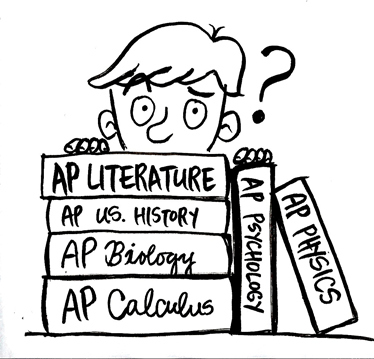
At CHS, AP classes have become a familiar part of schedule planning. For many students, deciding which APs to take is less about whether to take them at all and more about how many they can fit into their schedules. The courses promise academic challenges, potential college credit, and experience with college-level material. But they also come with a familiar reputation: AP classes are harder, and taking them demonstrates academic ambition.
Yet are all AP classes equally worthwhile? Which ones do CHS students actually enjoy, which ones feel like the most work, and which ones would they recommend to their classmates? And beyond individual courses, why have AP classes become so normalized that taking the hardest available classes can sometimes feel like an expectation rather than a choice?
A CHS student survey asked students to rate AP courses on a scale of 1 to 10 and share what they liked, disliked, and would recommend to future students. AP Research received the highest average among courses with multiple ratings, while AP Biology, AP Statistics, and AP Chinese also received strong reviews. Other courses, including AP World and AP English Literature, received more mixed ratings.
Honestly though, I didn’t think the results of the survey revealed anything we didn’t already know. Classes range in popularity based on the teacher and the student—if it’s a class people do well in, they will rank it higher, and if it’s a subject they struggle with, they will rank it lower. Rankings are subjective, but this led me to wonder: why do we take so many AP classes in the first place?
The popularity of AP courses at CHS makes more sense in the context of how the program developed across the United States. AP was not originally intended to become a standard feature of nearly every high school schedule.
The program’s roots date to the period after World War II. The Ford Foundation’s Fund for the Advancement of Education supported efforts to improve coordination between high schools and colleges, including the development of courses and assessments that colleges could recognize as sufficiently rigorous for advanced placement or credit. A pilot program covering 11 subject areas began in 1952, and the College Board took responsibility for AP in 1955, according to a 2025 study published in Education Finance and Policy. (The Advanced Placement Program and Educational Inequality – Available).
The first year of participation recorded by the College Board, 1955–56, involved 1,229 students at 104 schools, who took 2,199 exams. Those numbers are a far cry from today’s program. In the 2024–25 school year, approximately 3.24 million students across 23,664 schools took more than 6.18 million AP exams, according to the College Board’s annual participation report. (https://apcentral.collegeboard.org/media/pdf/annual-ap-program-participation-1956-2025.pdf).
The change is not just a matter of more students taking more tests. AP has become woven into the structure of American high school education. According to the College Board’s AP program results for the class of 2025 (Class of 2025 Builds on a Decade of Gains in AP Participation and Performance – Newsroom), more than 1.3 million students in public high schools took AP exams that year. 37% of public high school graduates had taken at least one AP exam, up from 34.3% in the class of 2015.
The program has also expanded its reach. The College Board reports that about 79 percent of American public high school students attend schools offering at least five AP courses. AP is no longer limited to a small group of schools or students. Its expansion reflects efforts to give more students access to advanced coursework and the opportunity to demonstrate college-level knowledge.
The expansion of AP has brought many benefits. Students can encounter more challenging material before college and potentially earn credit that saves time or money later. But growth has also changed the role AP plays in students’ lives. When many schools offer numerous AP courses, the courses can become not just opportunities for advanced study but an increasingly familiar marker of academic achievement.
At some schools, AP can begin to function as the next rung in the course hierarchy, much as honors classes may have served students in earlier generations. The point is not that AP and honors courses are identical. AP has a standardized exam and the possibility of college credit, while honors courses are generally structured differently. But the status attached to the label can make students feel that the most advanced available option is automatically the best one.
If AP credit is not guaranteed, why do we take them?
College credit remains an important reason students take AP courses. It has not disappeared from the program: the College Board reported that more than 2,100 colleges and universities awarded credit for AP scores in at least one subject in 2025. But credit policies vary by institution and exam, and students should not assume that every college will award credit for every qualifying score.
Even when credit is available, it is not the only reason to take an AP class. Students might want to explore a favorite subject in greater depth, challenge themselves academically, build skills that will be useful in college, or develop a stronger understanding of a topic they care about.
The CHS survey illustrates these differences. The student who praised AP Biology focused on its content and labs. The AP Physics 1 respondent enjoyed the subject while acknowledging the time commitment. The AP Seminar reviewer emphasized college preparation and relationships with classmates. The APUSH reviewer, in contrast, felt that the workload sometimes interfered with the enjoyment of history itself.
The most revealing comparison may be between those who described an AP class as worthwhile because of what they learned and those who discussed it primarily in terms of credit or manageability. Both considerations are understandable. Earning credit can make college more affordable, and a manageable workload matters when students are balancing several demanding classes. But when those factors become the main reasons to choose a course, it is worth asking what happens to curiosity.
It is also worth remembering that a demanding class can be valuable without being enjoyable every day, and an enjoyable class does not have to be the most difficult one available. Students have different strengths, interests, and responsibilities. A schedule that allows one student to thrive may leave another with too little time to explore other subjects or participate in activities outside the classroom.
Taking AP classes can certainly signal a willingness to pursue academic challenges. The problem arises when the signal becomes more important than the learning itself. If students take a course because they feel that they should, rather than because it fits their goals, the AP designation risks becoming a symbol of rigor instead of a means to experience it.
AP classes are neither inherently overrated nor automatically worthwhile. They offer opportunities that students should be able to pursue, but their value depends on how those opportunities are used. Their purpose should be to help students learn and grow, not to create an endless competition over who can take the most advanced courses.
