
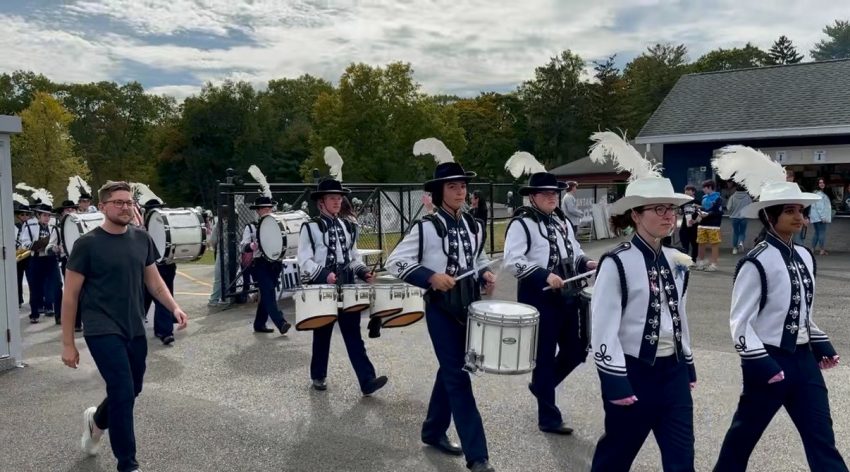
Listed under “Fall Sports” in the yearbook, but also a part of the performing arts, the marching band sits in a very unique spot at Chatham High School. It’s not recognized completely as a sport (even though its members receive varsity letters), and it is so much more than a simple extracurricular activity. As a member of the CHS Marching Cougars, I can affirm of our endeavors. We compete at multiple competitions and dedicate hundreds of hours over the season, but one thing is missing to compensate for our efforts: a gym exemption.
The marching band season can be intense. Sometimes, the days start at 9 am and end at 8 pm when we have competitions. It can require as many (or more) hours as athletic activities. Drum major Teesta Bhola-Shah says, “As a rising senior, I have a heavy coursework load next year—and I know most members do too. Marching band takes up many hours of the week between official rehearsals and at-home practice. A gym exemption for the season would provide needed time for assignments and take off a lot of pressure.”
The season begins in late August with band camp, 6 days straight of 8-10 hour days learning new music, and ends with the football team finishing play-offs. Each week during the season, there are 10+ hours of scheduled practice. On the weekends, there is a football game (and half-time performance if it is at Cougar Field), and frequent competitions with rehearsal prior to them. Critics may argue that marching band is not a physical activity, and to them I propose that they walk from CHS to Cougar Field in woolen uniforms (and Dinkles) in late summer and then play music for over 2 hours. Percussion members must march with large equipment and transport it, whereas the color guard has to practice with heavy equipment and do intense training. The combined effort and workload prove that the marching band is so much more than just playing music.
These practices meet the state legislature requirements for physical activity, which require at least 150 minutes of physical education/health every week (N.J.S.A. 18A:35-5, 7, and 8). Alongside that, the Chatham BOE rules for gym exemption state, “Students must attend a minimum of 3 practices and/or games each week to maintain the exemption. If fewer than 3 are met, the exemption will be removed.” Both marching band and athletics meet this criterion, so why does only one get a gym exemption?
A gym exemption for marching band is not an uncommon practice. Locally, Randolph High School has the Option II program available for PE, stating “participation in the sport/activity must occur during the school calendar year, meet or exceed the 150-minute minimum per week and include organized competitions and/or performances,” which likely includes marching band. The Westfield School District in Union County allows a gym exemption for members of a “WHS interscholastic team, cheer squad or marching band” if they have no free period in their schedule.
Marching band has a similar schedule to cheerleading (including attending football games), and they rightfully get a gym exemption, but we don’t. Varsity cheerleader Lucy Paruta says, “I’ve attended a marching band practice, and they work just as hard as we do. We have similar practice schedules too, and they show up to every football game with us. Cheer and marching band are pretty similar, and we work together in a lot of ways.” Marching band meets the local and state-wide requirements for exemption, performs at a competitive level, and takes a significant amount of time and skill. Some extra time to prioritize academic studies could lessen the load on overwhelmed students and provide even better competitive results.
Marching band is athletic, takes skill, and requires immense amounts of time. So, to the Chatham Board of Education, I propose that you amend the CHS athletic handbook to be more detailed, or include marching band in future gym exemptions.
