
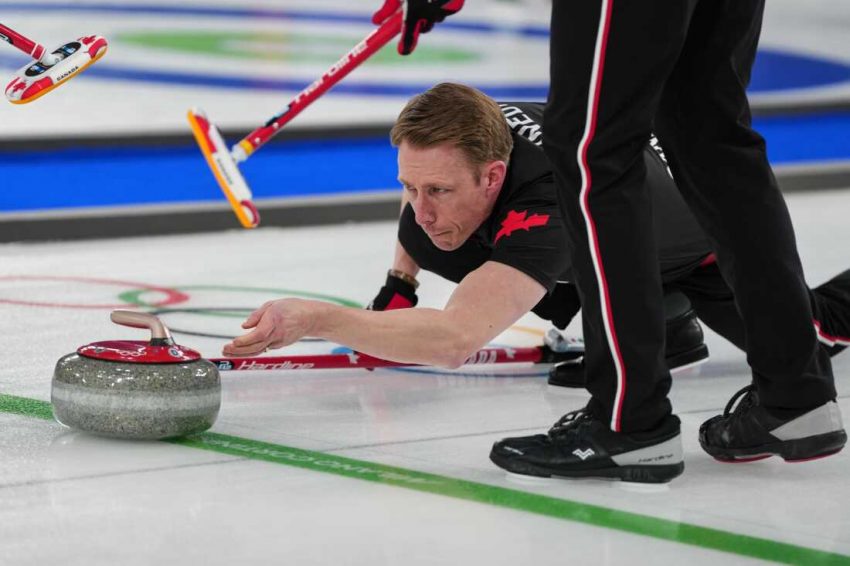
This winter’s Olympics have come and gone, and it’s safe to say they didn’t disappoint. There were countless compelling storylines, like Lindsey Vonn’s comeback, Norway’s utter dominance, Mikaela Shiffrin’s redemption, and Team USA’s remarkable victories in both men’s and women’s hockey. Yet amid all the excitement, one major scandal flew under the radar: cheating accusations surrounding the Canadian men’s curling team. To understand whether the team actually broke the rules, however, it is necessary to first revisit the history of this often overlooked sport.
The objective of curling is to land a stone as close as possible to the center of a circular target. Points are scored based on proximity to the bullseye, which is the center of the target. Two teams, each consisting of four players, take turns sliding a stone across a sheet of ice towards the house, a curling term for the circle. When the stone is released, it naturally creates a curved path known as a “curl.” This trajectory can be altered by the usage of brooms, as “sweepers” move alongside the stone and brush the ice directly in its path. The purpose of this is to reduce friction, which slows the stone down and creates more curl.
In organized competitions, each team throws eight stones per end, with each player contributing two throws. After all players have thrown their stones, the round is called an “end.” In the Olympic Games, ten ends are played, and the team with the highest total score at the end of those rounds is declared the winner.
There is evidence that curling was first played in Scotland during the early 16th century. However, the word “curling” did not appear in print until much later in 1620, when it was mentioned in a Scottish newspaper. In Scotland, the sport is also known as the “roaring game,” a nickname that comes from the rumbling sound the stones make as they travel across the ice. The Kilsyth Curling Club in Scotland, which claims to be the first organized curling club, was formed in 1716, and, not long after, the first official rulebook for the sport was created. Back then, the playing stones were flat stones from rivers and lakes, unlike the meticulously prepared, perfectly rounded stones that are used today. Curling was also commonly played outdoors on frozen rivers and ponds rather than on the carefully maintained ice sheets used in modern competition.
Today, the sport is most commonly associated with Canada, where Scottish immigrants introduced it. In fact, the Royal Montreal Curling Club, established in 1807, is the oldest active sports club in North America.
The first Curling World Championship, originally a men ’s-only competition (though both men and women now play it), was held in 1959, with Canada emerging victorious. Curling has been an official Olympic sport since 1998. Unsurprisingly, Canada has dominated Olympic curling competitions ever since. The Canadian men’s team has earned seven Olympic medals, while the women’s team has won five. Canada’s mixed team also secured a gold medal in 2018.
All of this brings us back to the cheating scandal. After so many years of dominance, you would think Canada’s men’s team would not feel the need to bend the rules. Yet, after failing to medal in 2018 and “only” earning a bronze in 2022, they were desperate to return to their former glory. Last weekend, they earned the gold, but the victory was quickly surrounded by controversy. Sweden’s Oskar Eriksson accused Canadian vice skip Marc Kennedy of touching the stone after it crossed the hog line, the latest point at which a stone can legally be touched. Canada vehemently denied these accusations, but Sweden utilized an alternative camera angle, separate from the one seen by officials, which appeared to show Kennedy slightly altering the stone’s path after it crossed the line. Yet, Sweden was powerless to do anything other than complain, as Olympic rules state that no outside camera angles can be used by the referees. Because Kennedy’s alleged contact was not visible to the naked eye or on the official camera used by referees, no penalty was issued. The incident has since sparked debate within the curling community: should additional camera angles be allowed in future Olympic competitions to prevent a similar controversy?
